
Why I Love Systems and Tools (Hint: It’s Actually About People)
May 29, 2026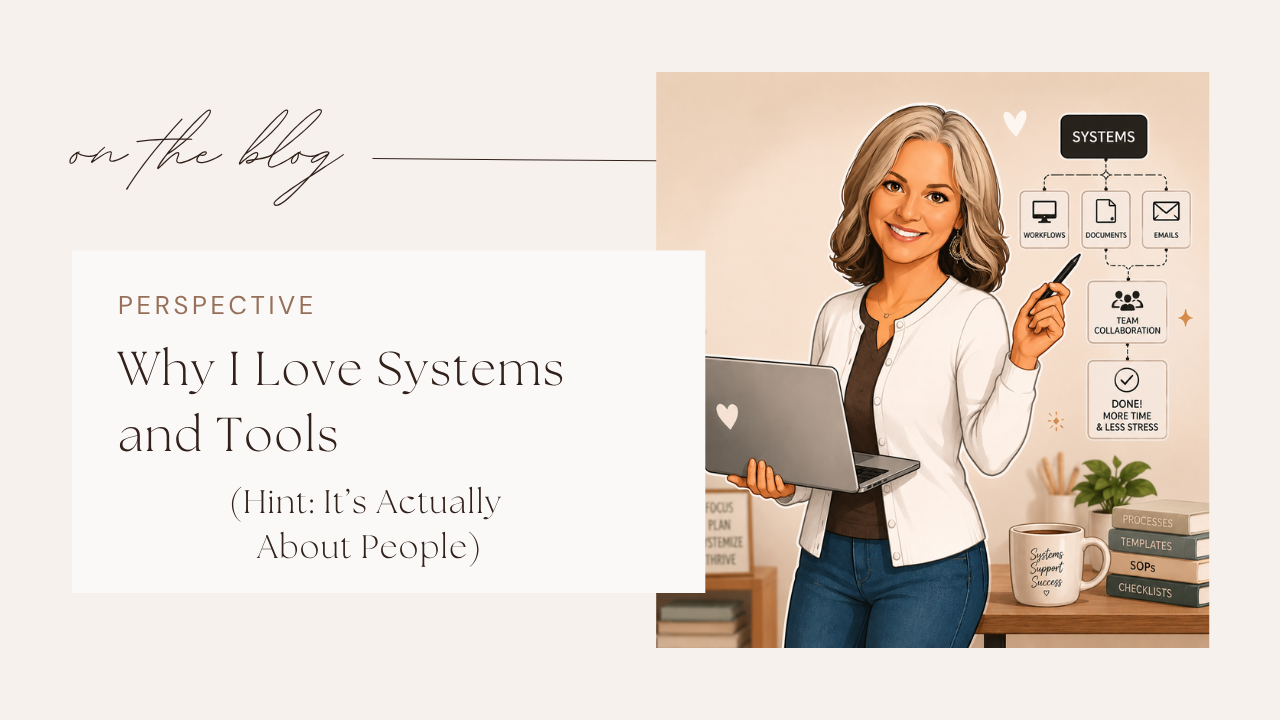
One of the things people often say to me is:
“Well… I know you LOVE systems and tools…but I just like to help people.”
And every time I hear that, I smile a little because the truth is:
I love systems and tools because I love people.
Not more than people.
Not instead of people.
For people.
For the overwhelmed teacher trying to hold everything together.
For the school administrator carrying invisible stress all day long.
For the paraeducator who desperately wants to support students well but doesn’t know where to find the information they need.
For the team member who feels buried under communication, unclear expectations, and constant reactivity.
For the leader who spends more time searching through emails than actually leading.
The older I get, the more I realize that many of the problems we experience at work are not really “people problems.” They are often systems problems that eventually become emotional problems.
Unclear communication.
Undefined ownership.
Scattered information.
Inconsistent expectations.
Invisible labor.
Decision fatigue.
Constant interruptions.
Lack of clarity around priorities.
When these things pile up long enough, people begin to feel:
- anxious
- disconnected
- resentful
- reactive
- emotionally exhausted
And then organizations often try to solve that exhaustion with one more motivational speaker, one more initiative, or one more piece of technology.
But technology by itself is not the answer.
In fact, poorly implemented systems can make things worse.
I think this is why so many conversations around AI and automation feel emotionally complicated right now. The question isn’t simply:
“How do we automate more?”
The deeper question is:
“What kind of emotional climate are we creating?”
Are we creating environments where people feel:
- calmer?
- clearer?
- more supported?
- more confident?
- more connected?
- more able to communicate their needs?
Or are we creating environments where people feel:
- faster
- more monitored
- more overwhelmed
- more replaceable
- more disconnected from meaningful work?
That distinction matters deeply to me.
Because the healthiest systems are not designed to remove humanity from work.
They are designed to create more room for humanity.
Good systems reduce unnecessary cognitive load.
They help people stop carrying everything in their heads.
They reduce ambiguity.
They make communication clearer.
They create predictable rhythms.
They surface needs earlier before people hit burnout.
They help teams move away from martyrdom and toward sustainability.
And honestly? I think many people who “hate systems” don’t actually hate systems.
They hate systems that were built without empathy.
Cold systems.
Complicated systems.
Punitive systems.
Performative systems.
Systems that create more work instead of less.
But thoughtful systems?
Human-centered systems?
Calm systems?
Those can change people’s lives.
I have seen leaders become more present because they were no longer drowning in disorganization.
I have seen teams collaborate better because expectations became visible instead of assumed.
I have seen educators feel less anxious because resources, timelines, and communication finally lived in one place.
I have seen people regain emotional energy simply because the chaos was reduced.
That’s why I care so much about:
- dashboards
- workflows
- communication structures
- project management
- calendars
- templates
- automation
- clarity
Not because I worship productivity.
But because I care about human well-being.
At the end of the day, I don’t think the goal is to create workplaces where humans operate like machines.
I think the goal is to create systems that allow humans to breathe again.